veritas-kanban
Agent Providers
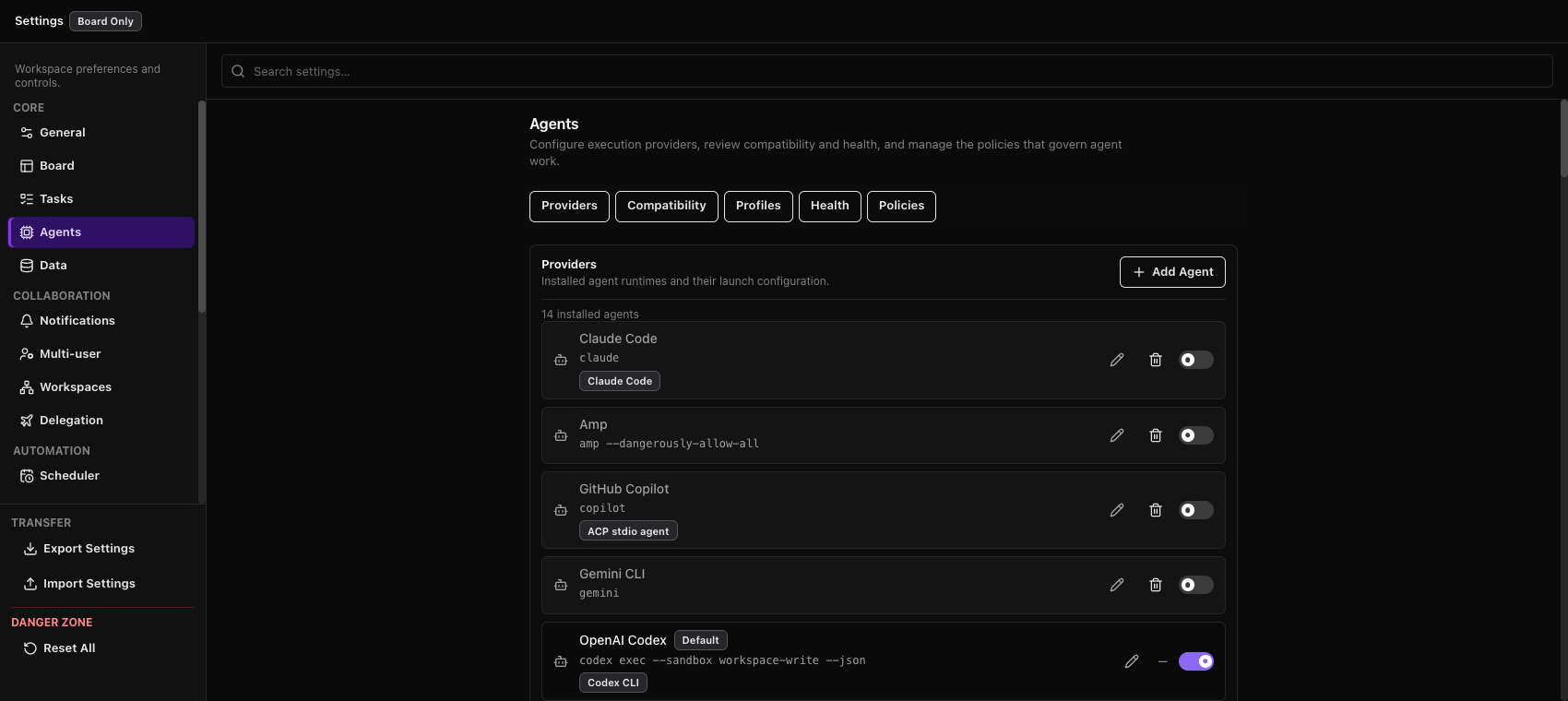
Veritas works as a board without any agent runner. When you do enable agents, provider profiles are configured in Settings -> Agents and are stored in the same app config for the web app and the macOS desktop app.
Defaults
Fresh v6 installs use OpenAI Codex as the default agent:
codexis enabled by default and usescodex exec --sandbox workspace-write --json.codex-sdk,codex-app-server,claude-code,copilot,acp-stdio, andhermeshave executable adapters but are disabled by default.amp,gemini,codex-cloud,ollama-local,ollama-cloud, andlm-studio-localremain visible for configuration and migration, but they cannot dispatch until a matching executable adapter ships.- Built-in routing sends code, bug, documentation, and review work to
codexfirst, with conservative fallbacks for higher-risk code paths.
Existing configs keep the user’s chosen default agent. Missing built-in profiles are added during config normalization without overwriting customized commands, arguments, or enabled states.
Claude Code v2.1.218
The first-class claude-code adapter contract is pinned to Claude Code
v2.1.218. Veritas launches the executable directly in the assigned worktree
with no shell and a reproducible system-owned argument set:
claude --bare --print --output-format stream-json --verbose \
  --include-partial-messages --include-hook-events \
  --forward-subagent-text --permission-mode dontAsk
The public Claude Code repository does not contain the complete CLI implementation. This contract is therefore pinned to the v2.1.218 release, official CLI/headless documentation, and checked-in golden stream fixtures; unknown versions invalidate conformance instead of inheriting certification.
The exact launch also disables slash commands and Chrome, caps turns at 100 by
default, applies an optional run cost budget, and derives allowed and denied
tools from the effective sandbox. Read, Glob, and Grep are available in all
sandboxes. Edit and Write require a writable sandbox. Bash requires both a
writable sandbox and network access. WebFetch and WebSearch are denied when
network access is disabled, and sensitive environment, secret, and credential
file patterns are denied. Caller arguments cannot replace these controls,
inherit settings/plugins/MCP configuration, select an unrelated session, or
bypass permissions. Veritas may append system-owned --resume <session-id>
and --fork-session only after the provider-neutral lifecycle validator binds
the exact source attempt.
--bare deliberately skips Claude Code’s local settings, plugins, MCP servers,
OAuth, and keychain state. Veritas therefore copies the worktree’s AGENTS.md
into the attributed task request and requires explicit bare-mode
authentication. Supported credential keys are ANTHROPIC_API_KEY,
ANTHROPIC_AUTH_TOKEN, ANTHROPIC_FOUNDRY_API_KEY,
ANTHROPIC_FOUNDRY_AUTH_TOKEN, AWS_BEARER_TOKEN_BEDROCK, and the bounded AWS
credential set used for Bedrock. Vertex requires an explicit
GOOGLE_APPLICATION_CREDENTIALS file reference. Vertex, Bedrock, and Foundry
selectors are allowlisted separately but do not prove authentication on their
own. Claude Code’s subprocess environment scrubbing is forced on so Bash,
hooks, and MCP subprocesses cannot inherit provider credentials. Arbitrary
custom headers, config directories, and unrelated credential-shaped
environment variables are not forwarded.
Readiness runs bounded claude --version, claude auth status, and
claude agents --json probes without a shell. The auth status probe is useful
diagnostic evidence, but only the explicit bare-mode environment satisfies
launch authentication. The runtime profile requires an exact
2.1.218 (Claude Code) version match and probe revision 16; version or build
drift invalidates conformance evidence.
Claude’s stream is consumed as bounded JSONL. Partial text/thinking, tool
use/results, hooks, subagents, retries, usage/cost, and terminal results map to
the shared causal event journal. The provider session_id is stored separately
from turn identity in run-event/v1 and on the attempt as its continuation
handle. Veritas waits for queued stdout processing and parses the final
unterminated record after process close, preventing the terminal result from
being lost during stream drain. A successful process exit without an
authoritative successful result record fails closed.
Resume and follow-up use the exact persisted session_id; fork combines
--resume with --fork-session so the source history is not mutated.
Interactive approvals, elicitation, steering, compaction, and archival remain
explicitly unsupported. Run-scoped MCP injection is supported through a
Veritas-generated --strict-mcp-config document and an exact
--allowedTools list. Only tools with an allow catalog decision are exposed
to Claude; approval-required tools remain available only through the
Veritas-mediated tool-call surface.
Credential-gated release smoke is opt-in:
VERITAS_CLAUDE_CODE_SMOKE=1 pnpm --filter @veritas-kanban/server exec vitest run \
  src/__tests__/claude-code-provider.smoke.test.ts
The smoke requires the exact certified executable and explicit bare-mode authentication. It runs one read-only, network-disabled, one-turn request with a $0.25 provider cap and verifies the authoritative result record. The normal test suite skips it.
OpenAI Codex app-server v0.145.0
Veritas supports three distinct Codex execution roles:
codex-cliremains the one-shotcodex exec --jsonadapter.codex-sdkremains the in-process SDK adapter.codex-app-serveris the supervised interactive JSON-RPC v2 adapter.
The app-server adapter is pinned to codex-cli 0.145.0, upstream tag
rust-v0.145.0, commit
25af12f7e61572b0bc18ddb1008be543b91519b0. Its checked-in schemas were
generated by that exact executable. The certified generated schema-set digest is
b59f4df6df8d00b3e665b533416efcfef9b5530bcd22a1e4a15dfe7bbd3a8624.
Version or build drift invalidates conformance evidence at provider probe
revision 12.
Veritas owns the launch:
codex app-server --stdio --strict-config \
  -c mcp_servers={} -c hooks={} \
  --disable plugins --disable apps \
  --disable in_app_browser --disable computer_use \
  --disable tool_call_mcp_elicitation
The process starts without a shell in the assigned task worktree. The safe
Codex environment preserves the normal authentication context and operator
allowlist while forcing
CODEX_INTERNAL_APP_SERVER_REMOTE_CONTROL_DISABLED=1. Live certification
requires the app-server to report remote-control status disabled.
The outbound method allowlist contains initialize, thread
start/resume/fork/compact/archive, and turn start/steer/interrupt. Veritas
initializes once, binds one task attempt to an exact thread and active turn,
persists thread/turn/item identity, validates every consumed request, response,
notification, and provider request, and maps streamed items, usage, file
changes, and authoritative turn/completed into the causal run journal and
completion contract. JSONL records are capped at 4 MiB. Uncorrelated or
schema-invalid records fail closed. Documented overload error -32001 receives
bounded exponential backoff.
The upstream thread/shellCommand method runs unsandboxed and is structurally
unreachable from Veritas. Command, file-change, permission, legacy exec/patch,
tool-question, and MCP elicitation requests enter the durable
run-approval/v1 broker. The exact action is hashed, the provider waits for one
authenticated compare-and-set decision, and the adapter sends a response
validated against the pinned method-specific schema. Rejection, expiry,
interruption, cancellation, stale evidence, and response errors fail closed.
Only tool questions are marked mobile-safe by this adapter; shell, filesystem,
network, permission, and MCP requests require a non-mobile reviewer.
Resume, follow-up, steer, fork, compact, archive, close, and crash reattachment
are capability-gated against the immutable runtime evidence. Native history
forks retain the parent conversation and optional source-turn boundary without
mutating the source. Inherited MCP servers, plugins, apps, hooks,
browser/computer tools, and remote control remain disabled. When a profile
selects MCP definitions, Veritas passes only the immutable run catalog as
thread-scoped mcp_servers configuration. Approval-required tools are disabled
in native configuration and must use the mediated tool-call surface.
Credential-gated release smoke is opt-in:
VERITAS_CODEX_APP_SERVER_SMOKE=1 pnpm --filter @veritas-kanban/server exec vitest run \
  src/__tests__/codex-app-server-provider.smoke.test.ts
The smoke requires the exact authenticated v0.145.0 executable, runs one read-only task-bound turn, verifies the authoritative completion text, and confirms remote control remains disabled. The normal test suite skips it.
ACP stdio agent provider
The acp-stdio provider is the generic stable Agent Client Protocol v1 adapter.
Use it for an agent runtime that implements JSON-RPC over newline-delimited
stdio. The configured command is the ACP server executable itself; Veritas
starts it without a shell in the assigned task worktree.
{
  "type": "my-acp-agent",
  "name": "My ACP Agent",
  "command": "/absolute/path/to/my-acp-agent",
  "args": ["--stdio"],
  "enabled": true,
  "provider": "acp-stdio",
  "model": "provider-owned-model"
}
Before changing attempt state, Veritas starts a bounded probe process and sends
ACP initialize with protocol version 1. The returned agent name, version,
capabilities, and a deterministic capability digest become
provider-runtime-manifest/v1 evidence at probe revision 16. Launch starts a
fresh process and rejects capability drift before opening or prompting a
session.
Supported mappings:
| ACP operation | Veritas contract |
|---|---|
session/new |
Fresh conversation-lifecycle/v1 session |
session/load or session/resume |
Exact persisted provider conversation |
session/fork |
Provider-native fork when negotiated |
session/prompt |
Attributed task-envelope turn |
session/cancel |
Cooperative run interruption |
session/close |
Provider close when negotiated |
session/update |
Ordered run-event/v1 journal records |
session/request_permission |
Exact-action run-approval/v1 request |
The runtime receives only the standard safe process context, the effective sandbox environment allowlist, and environment keys required by the immutable run tool catalog. Values are never written to manifests or logs. Stderr is bounded and redacted, JSON-RPC records are capped at 1 MiB, pending requests have bounded timeouts, and the supervised process group receives a graceful termination followed by a bounded force-stop.
Run-scoped MCP definitions are translated into ACP session configuration.
Native injection is allowed only when every discovered tool on a selected
server has an allow decision. ACP v1 cannot express per-tool deny or approval
rules, so a partial catalog fails closed instead of exposing extra tools.
Credential-bound native server definitions remain omitted. Selected
credential-bound tools use the system-owned veritas-run bridge, which binds
an opaque in-memory handle to the exact run catalog and consumes one-shot
credential leases only inside the mediated downstream call.
Expose Veritas sessions to ACP clients
The inverse ACP server view lets an editor or another ACP client operate one Veritas-managed task without creating a second session store:
vk acp status --json
vk acp serve --stdio --task TASK-001
vk acp status --json reports API reachability, protocol methods, and the
authenticated role/workspace context. Individual operations continue through
the existing permission guard. vk acp serve --stdio writes protocol records
only to stdout. Diagnostics remain on stderr.
The process may bind one task with --task; otherwise session/new must
provide _meta["veritas/taskId"]. The client cwd must exactly match the
task’s active worktree. A deterministic task-derived ACP session ID maps
session/new, session/load, session/resume, session/prompt, and
session/cancel onto the existing conversation lifecycle, supervisor,
run-event journal, approval broker, and launch evidence. Optional
_meta["veritas/afterSequence"] provides cursor replay after reconnect.
The first prompt starts a fresh provider conversation while retaining the
immutable task envelope. Later prompts use the attributed follow-up path.
Permission requests are relayed to the ACP client and decided through the
durable exact-action approval broker. Client-owned MCP server definitions are
rejected because Veritas owns the run tool catalog. Closing stdin or
disconnecting the client leaves the durable run active; session/cancel
interrupts the current conversation and never invokes task stop.
See ACP Provider v1 architecture.
Buzz Agent ACP
buzz-agent is a built-in, disabled-by-default runtime profile under
acp-stdio; it is not a new provider type. Veritas tests Buzz release
v0.4.24 at commit 710ed9fff57878a1d69f809b80a6ee0416c53fc4 and requires
the runtime to identify itself as buzz-agent 0.1.0 during ACP initialize.
Identity, version, capability, profile revision, release, and commit evidence
are included in the provider build digest and checked again at launch.
The tested profile supports fresh sessions, prompt completion, cancellation,
message/tool updates, and stdio MCP. It reports in-memory sessions, no
session/load, no HTTP/SSE MCP, and non-streaming LLM calls truthfully. Resume
therefore fails closed. buzz-acp is the inverse relay-side ACP client and is
never accepted by this profile.
When a run selects tools, the profile receives exactly one system-owned
veritas-run stdio MCP descriptor. The opaque handle is bound to the task,
attempt, immutable catalog, launch manifest, and lifecycle. Buzz reads the
selected catalog and makes allowed or approval-backed calls through that
bridge; unrelated or denied tools are absent or rejected. Native MCP
definitions, task credential values, the global Veritas MCP inventory, and
HTTP/SSE fallback are never injected.
Veritas does not install Buzz or Rust. Build or install buzz-agent, then
configure BUZZ_AGENT_PROVIDER plus the matching model and authentication
keys. The profile allowlists Buzz configuration and only these boot credential
keys: ANTHROPIC_API_KEY, OPENAI_COMPAT_API_KEY, and DATABRICKS_TOKEN.
They remain provider-required boot authentication, not task credential
brokering. Unrelated Buzz relay and server secrets are excluded.
GitHub Copilot CLI ACP (public preview)
copilot is a built-in, disabled-by-default runtime profile under
acp-stdio. The tested runtime is GitHub Copilot CLI v1.0.74, which
identifies itself as Copilot 1.0.74 during ACP initialize. The live
credential-free handshake advertises session loading, HTTP/SSE MCP, image and
embedded-context prompt input, and session listing.
Veritas owns this process-wide stdio baseline:
copilot --acp --stdio --no-auto-update --no-remote --no-remote-export \
  --disable-builtin-mcps --no-custom-instructions --no-ask-user \
  --no-experimental \
  --secret-env-vars=COPILOT_GITHUB_TOKEN,COPILOT_PROVIDER_API_KEY,COPILOT_PROVIDER_BEARER_TOKEN,GH_TOKEN,GITHUB_TOKEN
The profile accepts the agent model plus only bounded restrictive settings for available/excluded tools, denied tools/URLs, reasoning effort, context tier, and maximum AI credits. Broad allow, TCP, remote, plugin/config injection, prompt-mode, and unowned resume flags fail closed before an attempt is created. The same compiled argv is persisted in launch evidence and used for probe and launch.
Authentication remains provider-managed. copilot --version is safe and
non-consuming, but GitHub documents no stable non-consuming auth-status
command. Run copilot login or configure one of the allowlisted boot
credentials. Veritas passes no unrelated credential-shaped variables, and
the system-owned --secret-env-vars setting strips those keys from Copilot
shell and MCP subprocesses.
ACP support is public preview. The public repository is incomplete, and the
v1.0.74 tag currently resolves to commit
2b809c84e87dbcc88f897cb4f3fb97c43b77af95, whose commit message still names
v1.0.73 even though the release assets and runtime report 1.0.74. Veritas
records that provenance mismatch as a limitation and certifies the exact
release/version/handshake contract, not unprovable binary-to-source lineage.
Provider-managed COPILOT_HOME is inherited for login state, so the profile
also reports that it is not a fully isolated bare configuration.
Grok Build ACP
grok-build is a built-in, disabled-by-default runtime profile under
acp-stdio. Veritas tests the released Grok Build v0.2.111 executable,
which reports grok 0.2.111 (94172f2aa4e5) [alpha] and advertises
agentVersion: 0.2.111 in its ACP initialize metadata. The profile requires
session loading, HTTP/SSE MCP, embedded-context input, no ACP image input, and
the negotiated x.ai/fs_notify and x.ai/capabilities extensions.
Veritas owns this process baseline:
grok [restrictive global policy] agent --no-leader \
  [--model=<model>] [--reasoning-effort=low|medium|high] stdio
The optional global policy accepts only bounded deny rules, tool allow/removal lists, sandbox selection, and feature-disable flags. Approval bypass, reauthentication, shared-leader attachment, plugin/profile injection, endpoint overrides, prompts, worktree creation, and resume flags fail closed before an attempt is created. Veritas starts a dedicated process in the assigned worktree and owns session creation or loading through ACP.
Authentication is provider-managed. grok --version is the only readiness
probe; it does not authenticate or consume inference. Existing login state is
read through GROK_HOME, or operators can provide the allowlisted
XAI_API_KEY, legacy GROK_CODE_XAI_API_KEY, or GROK_DEPLOYMENT_KEY boot
credential. These remain provider authentication, not task credentials.
The exact macOS arm64 release artifact tested on 2026-07-24 has SHA-256
e1fafdfffe14f339460befaf194360e8f90bfd02efe8a4f24cfa1c7aea657ffe.
The stable channel currently serves an artifact that self-reports [alpha].
The reported build 94172f2aa4e5 is not present in the public repository, and
the current public source snapshot is newer than the release artifact.
Veritas records both provenance limits and certifies the exact executable
version/build/handshake contract instead of claiming an unprovable source
mapping. Other platform artifacts must report the same pinned version/build;
the macOS arm64 artifact is the credential-free smoke baseline.
Buzz communication harness
Buzz relay communication is integrated as a buzz communication adapter, not
as an AgentProvider. Settings and vk doctor can verify its relay/community
identity, NIP-98 signing identity, relay membership, read capabilities, tested
release contract, and optional local command versions without sending a
message. Task execution through the separately configured buzz-agent ACP
profile remains independent of relay delivery and never starts buzz-acp. See
Buzz Connection Diagnostics.
An operator can bind one active Buzz channel mapping to one Veritas workflow
with a buzz-workflow-trigger/v1 rule. The first supported event is a root
message.posted; replies, adapter-originated echoes, disabled rules, and
predicate mismatches never launch a run. Each accepted event is journaled
before dispatch with the causal key
buzz:{community}:{eventId}:{ruleId}. Replays return the existing run, and
restart recovery reconciles an accepted journal entry against workflow run
context before attempting dispatch again. The provider-neutral
workflow.pre-external-trigger runtime hook remains the policy boundary.
Rules and their bounded audit history are available under
/api/integrations/communication/adapters/:adapterId/buzz/workflow-triggers
and
/api/integrations/communication/adapters/:adapterId/buzz/workflow-trigger-audits.
Rule creation requires both integration settings write access and execute
permission on the destination workflow.
Harness Support Profiles And Tiers
Every configured agent is normalized to a harness-support-profile/v1 contract.
The profile records stable profile and adapter IDs, transport, executable and
non-mutating authentication probes, version/build invalidation policy,
platforms, launch/worktree behavior, environment and credential allowlists,
conformance fixture identity, documentation, and remediation. The contract
contains credential key names only, never credential values. Credential-like
launch arguments are replaced with [REDACTED] before the profile is exposed
or hashed, so rotating a secret cannot turn the profile digest into a secret
oracle.
Deterministic certification inputs use
harness-conformance-suite/v1. The runner resets a seeded fixture before each
trial, applies the same scenario across provider/model/profile/policy/sandbox
combinations, and emits harness-conformance-result/v1 with assertion,
failure-class, pass-rate, variance, latency, token, cost, retry, baseline, and
immutable evidence references. Run the credential-free recorded lane with the
documented run-harness-conformance.ts command; credential-gated lanes require
explicit opt-in.
See Harness Conformance v1.
The live status projection uses five tiers:
| Tier | Meaning |
|---|---|
detected |
The executable is installed, but the profile is disabled or not ready for dispatch. |
configured |
The explicit adapter is enabled and its runtime probe is ready, but current certification evidence is absent. |
certified |
The installed version, build, manifest digest, and probe revision match a passing conformance result. |
degraded |
The adapter exists, but installation, authentication, probe, compatibility, or certification evidence is unhealthy or stale. |
unsupported |
The profile has no executable adapter or does not support the current platform. |
Settings -> Agents displays the same tier returned in
GET /api/config/harness-compatibility. vk doctor consumes that compatibility
record unchanged:
an enabled degraded or unsupported profile is a blocking failure, while an
enabled configured profile is a warning until certification is current.
Reasons and remediation are redacted before leaving the server.
The reviewed builds, capability evidence, source-availability caveats, fixture
identity, and tier definitions are documented in
Harness Compatibility. The legacy
GET /api/config/agent-support endpoint remains available for API
compatibility, but new operator surfaces use the matrix response so they cannot
drift.
Task start rechecks the normalized profile before attempt state is created. An
explicit provider must match the profile’s executable adapter. A display-only
Copilot profile, an unsupported provider, or an unknown provider-less profile
fails with an actionable 409 and can never fall through to OpenClaw.
Recognized credential material in the configured command or launch
arguments degrades the profile and blocks dispatch before probing or attempt
creation. Put credentials in an allowlisted environment key or a run-scoped
brokered credential reference instead.
For backward compatibility, normalization migrates only known provider-less
Claude Code, Codex, and Hermes records when both the built-in type and command
identity match (claude-code plus claude -> claude-code, codex ->
codex-cli, hermes -> hermes-cli). The legacy Claude-only
--dangerously-skip-permissions default is removed during that narrow
migration. New and custom profiles must set an explicit provider. Command-name
inference is not a general adapter-selection mechanism.
Provider Runtime Manifests
Before a task attempt mutates task state, the selected execution adapter emits a
provider-runtime-manifest/v1 snapshot. The snapshot records the adapter and
protocol version, provider build/version evidence, configured models, probe
timestamp and diagnostics, and every known runtime or sandbox capability as
supported, advisory, unsupported, or unknown.
Veritas currently has executable task adapters for codex-cli, codex-sdk,
codex-app-server, claude-code, hermes-cli, and openclaw. An explicitly
configured Copilot, Codex Cloud, Ollama, LM Studio, or custom profile is not
silently sent through OpenClaw; task dispatch fails with an actionable 409
until that provider has an execution adapter.
The exact manifest and its sha256: digest are stored on the current attempt,
attempt history, optional run trace, and Markdown run log. Provider identity
evidence is collected on each launch. CLI/SDK identities come from bounded
runtime or installed-package probes, and conformance probes are bounded before
launch. An OpenClaw version supplied through the environment remains degraded
operator evidence until host registration can verify it. A matching
version/build can reuse conformance evidence for up to five minutes; a version
change invalidates it and reruns the probe. Failed probes and unknown versions
are not positively cached.
Capability states describe behavior that the current adapter actually proves. They do not imply that adjacent roadmap work already exists. For example, provider-neutral controls remain unsupported or unknown for an adapter until the runtime exposes a verified native operation. MCP governance is supported through the system-owned run bridge for Codex CLI, Codex SDK, Codex app-server, Claude Code, and ACP stdio. All-allow native catalogs remain available where the adapter can enforce them; Hermes and OpenClaw fail closed when a selected catalog requires the bridge.
One evaluator maps those capabilities to launch and run controls. Agent starts
always require run.start, run.status, run.logs, run.complete, and
workspace.worktrees; callers can add requiredRuntimeCapabilities. Profile
tools, MCP servers, token/cost/tool budgets, workflow sessions, structured
output, and saved artifacts add their own requirements before provider work
starts. supported and advisory evidence qualify; unsupported, unknown,
missing, failed-probe, invalid-digest, or mismatched active/persisted evidence
fails closed with concrete remediation.
The task status API returns a controls set derived from the persisted launch
snapshot. Stop, message/steer, completion, token reporting, logs, tool events,
and artifact ingestion compare the active and persisted manifest digests before
acting. Task Detail, Work view, and shared co-drive messaging disable actions
that the manifest does not support and show the evaluator’s reason.
Provider-Neutral Conversation Lifecycle
conversation-lifecycle/v1 is stored on every attempt. It records opaque
provider conversation, turn, and item IDs; parent attempt/conversation and fork
turn; lifecycle state; and measured context-window utilization. It deliberately
does not store process handles, credentials, leases, or other transient
authority.
| Task adapter | Resume/follow-up | Native fork | In-flight steer | Compact/archive |
|---|---|---|---|---|
| Codex CLI | Supported | Unsupported | Unsupported | Unsupported |
| Codex SDK | Supported | Unsupported | Unsupported | Unsupported |
| Codex app-server | Supported | Supported | Supported | Supported |
| Claude Code | Supported | Supported | Unsupported | Unsupported |
| Hermes | Unsupported | Unsupported | Unsupported | Unsupported |
| OpenClaw task mode | Unsupported | Unsupported | Unsupported | Unsupported |
Resume requires the exact source worktree. Fork permits a new worktree only when repository and base revision remain compatible. Both operations compare the source and target provider, adapter protocol, model, sandbox, tool, permission, and launch-policy evidence before attempt state is created. Restart-to-resume uses persisted provider identity and the durable supervisor event cursor; it never replays prior effectful prompts.
Lifecycle mutations are available at
POST /api/agents/:taskId/conversation/{action} and through
vk agent:{action} or the MCP control_agent_conversation tool. Supported
actions are resume, follow-up, fork, steer, interrupt, compact, archive, and
close. Every accepted action has auth-derived attribution and a causal
conversation.* journal event. Unsupported steering fails the capability
gate; any recorded-only fallback returns delivered: false. Generic process
stdin is not treated as provider delivery.
Workspace checkpoint rewind is deliberately narrower than ordinary conversation fork. POST /api/agents/:taskId/workspace/checkpoints/rewind is preview-first, requires exact critical approval, and is available only for an active Codex app-server attempt whose target checkpoint names an earlier exact turn in the same thread. Operators may resolve an attribution conflict per path with accept, reject, or leave-untouched; the selected paths and canonical decisions are digest-bound through approval, transaction, and recovery. Veritas interrupts the current turn, commits only the approved workspace paths, forks the approved provider history, and records the new live cursor plus its checkpoint anchor. Other adapters, ambiguous or item-level cursors, unresolved non-attribution conflicts, and changed current-state evidence fail closed.
Agents and supervisors can register the same validated manifest with
POST /api/agents/register and refresh it through the heartbeat endpoint. Host
provider, model, tool.*, and sandbox posture is derived only from those
manifests. Legacy free-form registration fields remain visible but are not
trusted for runtime requirements. Route and host-preview requests can declare
requiredRuntimeCapabilities; supported evidence qualifies, advisory
evidence qualifies with a warning, and unsupported, unknown, missing, or
failed-probe evidence rejects the candidate. All requirements must be satisfied
by one manifest, so capabilities are never composed across providers.
Self-registration requires an authenticated agent key/token whose identity
matches the registry agent ID; operators with agent:write can register on an
agent’s behalf. Unknown request fields and unredacted secret-like evidence are
rejected. Only registrations with a current five-minute heartbeat qualify for
routing. Provider version/build changes invalidate the readiness cache and
force a new conformance probe; active controls continue to use the immutable
snapshot persisted for that attempt.
Causal Run Event Journal
Executable adapters own a mapper into the shared run-event/v1 envelope.
OpenClaw, Codex CLI, Codex SDK, Codex app-server, Claude Code, and Hermes
preserve provider event identity, session/turn/item identity when the provider
reports it, provider time, receive time, source, causal links, and a monotonic
per-attempt sequence.
Known kinds cover run lifecycle, operator and assistant messages, deltas,
reasoning, progress, streams, commands, file changes, tools, approvals,
artifacts, usage, and errors. A new provider event that Veritas does not
understand is retained as a namespaced kind or provider.unknown; it is never
silently discarded or assigned semantics that the adapter cannot prove.
The journal is the ordering boundary for provider output. An event is appended
and fsynced or committed before legacy Markdown logs, traces, activity,
telemetry, budget accounting, completion state, or WebSocket output project
from it. Provider event IDs create stable deduplication keys. File mode stores
private per-task/per-attempt JSONL under .veritas-kanban/run-events/; SQLite
mode uses migration 0018_causal_run_event_journal and a transactional
per-attempt sequence. Each attempt is bounded to 50,000 events and file journals
to 128 MiB. Payloads are recursively redacted, strings and collections are
bounded, and payloads larger than 32 KiB are replaced by explicit dropped
metadata before persistence.
Launch previews expose current redacted provider and selected-host dependency circuit posture. run.started, launch-failure, and terminal journal records retain the corresponding run-dependency-circuit-evidence/v1 snapshot; run telemetry carries compact state counts; and normalized completion results add verified harness evidence for both circuit identities. These records contain opaque dependency IDs and policy/state metrics, never endpoint URLs, request bodies, response bodies, or credentials.
The TypeScript contract is in shared/src/types/run-event.types.ts; the
portable schema is shared/schemas/run-event-envelope.v1.schema.json.
Consumers replay with
GET /api/agents/:taskId/attempts/:attemptId/events?afterSequence=<cursor>.
WebSocket subscribers send taskId, attemptId, and afterSequence; Veritas
attaches the live listener before replay, buffers concurrent events, then
delivers one ordered agent:event stream. The older agent:output projection
remains for compatible clients. Existing Markdown attempt logs remain readable
and are not rewritten by the journal migration.
Task Envelopes And Commit Policy
Every launch also persists a provider-neutral task-envelope/v1 snapshot. It
binds the task and attempt identity, objective, background, constraints,
acceptance criteria, worktree identity, launch manifest, expected outputs,
verification gates, evidence requirements, and allowed side effects to one
canonical sha256: digest. The worktree baseline records HEAD plus every
dirty file that existed before launch, including its staged index blob and
worktree-content SHA-256. Capture retries when HEAD, status, or fingerprints
move and fails closed after three unstable attempts, so later completion
evidence cannot claim pre-existing changes.
Worktrees created by Veritas also carry a durable worktree-manifest/v1
allocation. Before dispatch, the attempt claims its ownership lease. The task
envelope and run launch manifest bind the worktree manifest ID, lease ID,
owning attempt, exact resolved base commit, and whether that base came from a
successful remote fetch or an explicit stale-local acknowledgement. Legacy
worktrees remain readable, but their launch manifests identify the launch HEAD
as legacy evidence instead of presenting it as a remotely resolved base.
Commit behavior is explicit instead of implied by a shared prompt:
forbiddendoes not authorize a commit.allowedauthorizes a commit but does not require one. This is the compatible default for existing tasks.requiredrequires completion evidence for a commit created after the launch baseline.
A one-off commitPolicy start value overrides task.executionPolicy, which
overrides the legacy features.agents.autoCommitOnComplete setting. Legacy
true maps to required; false or an absent value maps to allowed.
Requested filesystem, process, commit, and artifact scopes are intersected
with the effective worktree sandbox; ancestor requests such as / are clamped
to the assigned worktree and disjoint paths are rejected.
The start response, active status response, task attempt/history, and Markdown
run log expose the same immutable envelope.
Provider-Owned Transport Rendering
Each executable task adapter renders the provider-neutral envelope into its
own immutable provider-task-envelope-transport/v1 request. OpenClaw, Codex
CLI, Codex SDK, Codex app-server, Claude Code, and Hermes renderers all include
the envelope digest, runtime identity, objective and bounded context, a bounded
workspace-baseline summary, explicit commit policy, allowed side effects,
expected outputs, verification gates, and completion evidence contract.
When reviewed reflection lessons are relevant, every renderer also receives
the same bounded Accepted Memory section. Each entry includes its stable
reflection ID and source task, run, and event attribution. Harnesses should
treat these as human-reviewed supporting guidance and preserve the identifiers
when reporting whether a lesson helped or regressed the run.
Profile instructions and saved task checkpoints are rendered as separate,
attributed sections and are capped at 20,000 characters each. The persisted
task envelope retains the complete baseline fingerprints used for later
attribution.
The callback posture belongs to the adapter:
- OpenClaw receives the attempt-bound Veritas completion callback, including the provider-runtime manifest digest.
- Codex CLI returns terminal output through the supervised process.
- Codex SDK returns terminal output through the captured SDK event stream.
- Codex app-server returns terminal output through its validated
turn/completednotification. - Claude Code returns its authoritative terminal result through the drained stream-json process output.
- Hermes returns terminal output through scripted process stdout.
Process and stream adapters are explicitly told not to call the Veritas
completion endpoint. None of the renderers claims provider-native structured
output; Veritas owns validation and completion normalization. The exact
rendered request is fingerprinted as instructions.effective-task-request in
the run launch manifest, and the provider and adapter must match the envelope
before dispatch.
Authoritative Completion Results
Every terminal transport is normalized into one immutable
completion-result/v1: supervised process exit, SDK stream, OpenClaw callback,
remote-session report, or operator interruption. The result persists on both
the current attempt and attempt history with a canonical digest, a
claim-derived idempotency key, completion timestamp, and terminal source.
Exact duplicate callbacks are safe after persistence or restart. A callback
with different content, attempt identity, or provider-runtime digest returns
409 Conflict and cannot replace the first terminal owner.
Callback and remote-session terminal sources are accepted only for OpenClaw.
CLI process and SDK stream providers reject callback transport even when an
attempt ID and manifest digest are known.
Terminal task mutation crosses one AttemptLifecycleCoordinator seam. The
coordinator validates the persisted runtime, envelope, and optional launch
manifest bindings; enforces active-attempt ownership; retries bounded task
revision conflicts; updates current and historical attempt state together;
and treats only the exact persisted idempotency key as a safe duplicate.
Provider adapters and restart recovery prepare evidence but cannot implement a
parallel terminal persistence path.
RunRecoveryCoordinator owns restart reconciliation, retry/fallback decisions, scheduled retry timers, and recovered-process monitors. Its public entry points reconcile persisted work, inspect/cancel recovery, claim a retry after admission, and plan from a failure or completion. The host supplies explicit task, journal, supervisor, and launch ports; verified reattachment and exactly-once completion remain with the existing admission and attempt owners. Timers are scoped to one coordinator, and disposing it cancels only its timers. Provider selection, immutable binding checks, fallback eligibility, and retry idempotency are unchanged.
Provider summaries, evidence, artifacts, and verification claims are bounded,
redacted, and stored as unverified provider evidence. Veritas independently
captures Git HEAD, post-launch files and commits, task verification state,
local file artifacts, and observable side effects through the replaceable
CompletionEvidenceSource port. Unchanged dirty files from the launch
baseline are excluded. The launch baseline records commits already reachable
from other refs, so switching or fast-forwarding to pre-existing history is
not credited to the attempt. Required commits, forbidden commits, missing
verification, missing required outputs, and unauthorized side effects
downgrade a claimed success to recoverable partial.
Completion status maps to task state as follows:
successmarks the attempt complete and the task done.blockedmarks the attempt failed and the task blocked.failed,interrupted, andpartialmark the attempt failed and return the task to in-progress recovery.
The legacy bounded { success, summary, error } OpenClaw callback remains
accepted and is normalized into the same contract. New callbacks may report
the explicit status, blockers, provider evidence, artifacts, verification
claims, and a continuation handle. Codex CLI, Codex SDK, Codex app-server,
Claude Code, and Hermes still use their native harness-owned terminal paths
rather than the callback endpoint.
Every current launch also owns a durable run-supervisor/v1 record. The record
binds provider and adapter identity, runtime/task/launch digests, worktree
fingerprint and lease, budget snapshot, last durable event sequence, host
identity, and a process-group or remote-session control handle. The file and
SQLite repositories use revision compare-and-set, and an expiring
owner/host/process lease permits exactly one recovery supervisor.
After restart, local Codex CLI, Codex app-server, Claude Code, and Hermes runs reattach only when the original PID, process group, start identity, host, and immutable bindings still agree. Projection replay starts strictly after the stored run-event cursor through the durable journal subscription. Startup reconciles any journal gap after that same cursor. A terminal supervisor record carries the exact normalized completion result, so a crash between terminal ownership and task mutation finishes idempotently on startup. Remote sessions are probed only when their adapter declares reattach or resume support. Missing evidence, unreachable sessions, reused PIDs, foreign hosts, legacy in-process state, and binding drift create a typed recovery reason and recommended next action; they never start duplicate work or signal an unverified process. OpenClaw callbacks remain authoritative for task-session completion.
Effective Run Launch Manifests
Every executable task launch also compiles run-launch-manifest/v1 before
attempt state is mutated. It references the task envelope instead of copying
its task contract, and records the selected provider/model/transport, redacted
command and arguments, instruction fingerprints and precedence, environment
key names and broker references, profile tools/MCP/permissions/health checks,
sandbox/network posture, readiness and any hashed operator override, budget,
routing/fallback, workspace trust, compiled phase evidence and source
references, and the origin of each effective value. Prompt content, override
text, and credential values are never stored in this manifest.
POST /api/agents/:taskId/launch-preview returns the same compiled contract
without creating an attempt or dispatching a process. The CLI equivalent is
vk launch-preview <task>. Preview applies the same readiness gate as start.
A profile restriction that the selected adapter
cannot enforce is returned as a concrete blocker, and start rejects it before
pending or task attempt state changes. Declaring tool.calls support is not
treated as proof that an adapter can enforce a named allowlist.
Phase authority is resolved at the same pre-mutation boundary for task and workflow launches, retries, fallbacks, conversation continuations, compaction controls, and provider handoffs. A descendant intersects the exact parent launch or current transition evidence, so changing providers or omitting an explicit phase cannot widen authority. Explicit phase launches fail closed with typed blockers when the runtime, sandbox, host, or tool policy cannot prove a required dimension. Tool-command and external-action enforcement support is delivered separately in #1033; prompt text is never accepted as enforcement.
Repository-controlled instructions and executable configuration pass through the provider-neutral workspace execution trust gate before Veritas reads repository instructions or creates an attempt. The gate fingerprints the exact task worktree, inventories recognized instructions, hooks, MCP servers, provider overrides, language-server settings, workflows, extensions, skills, and agent definitions, and evaluates them against an actor-attributed operator decision. Executable configuration requires explicit authorization. Model-only instructions may run provisionally only in enforced restricted mode.
The immutable launch manifest records redacted identity and inventory evidence, the effective decision, project maximum, requested capabilities, and restriction checks. Veritas rescans immediately before provider creation; an identity, inventory, or decision change aborts the launch. Repository policy can only narrow operator trust. See Workspace Execution Trust.
Codex app-server and Claude Code inject a positive MCP catalog through their native run-scoped configuration. Other task adapters reject non-empty MCP selections. All adapters continue to reject named-tool restrictions they cannot enforce; prompt text is never accepted as equivalent enforcement. Approval-required MCP tools are withheld from native provider configuration and can be called only through the Veritas-mediated approval path.
Launches can pass parentAttemptId to compare replay, resume, or fork inputs.
The comparison ignores attempt IDs, capture/probe timestamps, and other
ephemeral metadata while detecting changes to task policy, provider capability
posture, model, instructions, sandbox, budget, routing, and profile controls.
The manifest, optional parent drift, and governance trace ID are persisted on
the attempt and copied into attempt history. Active run controls compare the
stored launch digest as well as the provider-runtime digest. Completion packet
metadata links both digests, the provider probe revision/version/build, the
governance trace, and parent drift result.
Sandbox launch checks resolve every preset rule through the same manifest. Settings dry-runs send the digest of the newest matching manifest registered by a live host; the server resolves that digest rather than trusting a caller-supplied capability object. A missing, expired, unknown, or provider-mismatched digest fails closed. Required presets block on unsupported rules, while advisory presets record warnings and governance evidence.
Workflow agent steps currently execute through the codex-sdk and openclaw
workflow adapters. A workflow configured with codex-cli, hermes-cli, or
another provider is rejected before probing or launch instead of validating one
runtime and executing another. The workflow run persists the manifest and
derived controls before provider execution, then gates resume/reattach, tools,
MCP, structured output, token usage, and saved output artifacts from that same
snapshot. Capability evidence is surface-specific: OpenClaw task manifests do
not claim workflow-only follow-up, reattach, or output-artifact behavior, while
workflow manifests use the openclaw-workflow-session/v1 protocol evidence.
Token telemetry is required only when the effective step budget includes token
or cost limits; runtime-, retry-, or fan-out-only budgets do not require it.
Sandbox Policy Presets
Use Settings -> Agents -> Sandbox Policies to manage reusable filesystem, network, environment, and credential controls for agent execution. Built-in presets are immutable; custom presets can be created, edited, disabled, or deleted.
Presets can be assigned to:
- An agent profile, as the default guardrail for that provider.
- A workflow agent, as the guardrail for that workflow role.
- A one-off agent start request, by passing
sandboxPresetId.
The launch path dry-runs the selected preset before starting any executable provider adapter. Required controls fail closed when the provider or execution host cannot support them. Advisory controls continue with warnings and a governance trace. Settings also includes a dry-run panel that shows effective sandbox mode, network access, environment allowlist, unsupported controls, and the trace ID.
Selective network policies for local task and workflow providers start an
authenticated, run-scoped loopback gateway before dispatch. Durable launch and
gateway evidence records only the injected proxy key names and policy digest;
tokens and proxy URLs are never persisted. HTTP, HTTPS CONNECT, and plaintext
WebSocket transports use the evaluated DNS address. ALL_PROXY exposes a
separate authenticated socks5h listener with the same host, address, approval,
and audit policy; encrypted SOCKS tunnels fail closed when method or path
inspection would be required. Both listeners stop during terminal cleanup.
OpenClaw is provider-managed and cannot receive this local boundary, so a
required fine-grained policy blocks its launch.
Operators that require a corporate or audited proxy can set
VERITAS_EGRESS_UPSTREAM_PROXY to an HTTP proxy origin. The gateway evaluates
the destination first, pins the resolved address, and then opens an upstream
CONNECT tunnel to that address. Proxy credentials remain memory-only; durable
evidence records only upstreamMode: http-connect.
When a preset enables scoped approvals, an otherwise eligible block creates a
durable, exact-action network approval and holds the request at the gateway.
Only an approved request proceeds. Explicit host denies and protected address
classes are never approval-eligible. Gateway shutdown aborts pending waits.
Every final decision also emits a network.egress telemetry record containing
the hashed host key, run key, policy digest, protocol, port, decision, reason,
and approval ID when present. URLs, query strings, headers, bodies, proxy
credentials, and raw paths are excluded from telemetry.
Local ACP, Claude Code, Codex app-server, Codex CLI, and Hermes processes use a
version-bound codex sandbox wrapper when its credential-free conformance
probe passes. The wrapper enforces the compiled read, write, deny, dotfile, and
protected-metadata rules before the provider starts and applies to descendant
processes. Codex SDK and remote OpenClaw runs cannot use that outer process
wrapper. They satisfy required filesystem policies only when the exact
provider runtime manifest proves every active filesystem capability, including
descendant inheritance, run-scoped temporary storage, and cleanup. Coarse
provider modes such as workspace-write remain advisory.
Workspace and home aliases cannot escape their canonical base. Nested mounts below an allowed root are denied unless explicitly granted or denied, and the mount topology is rechecked before activation. Provider-native local enforcement blocks if Veritas finds an ambiguous nested mount that it cannot add to the native policy. The bounded workspace tree is also scanned before compilation and immediately before activation for pre-existing hard links that alias inaccessible external inodes.
The immutable launch manifest records the backend, versioned capability
contract, executable-content digest, provider runtime manifest digest, policy
hash, and only hashes of canonical paths. .git, .agents, .codex, and
.veritas-kanban remain explicitly read-only directly beneath writable roots,
and cannot themselves be selected as writable policy roots. Local wrapper and
provider-native runs use supervisor-owned temporary and cache directories;
remote native backends must prove their own run-scoped storage and cleanup
contract. See
Run-scoped filesystem sandbox backends
for the enforcement and failure contract.
There is no per-run override for a required filesystem boundary. The
overrideReason launch field applies only to task readiness. Intentionally
relaxing filesystem enforcement requires an authorized advisory preset, and
the effective decision remains recorded in policy and launch governance
evidence.
Credential references and environment-style name=value values are redacted from dry-run output and governance traces. Prefer brokered credential presets for workflows that need scoped secrets instead of exposing broad environment passthrough.
Credential definitions are admin-managed at /api/credential-broker. Records
contain only source references, public scope, TTL/use policy, approval posture,
and canonical digests. The broker issues opaque, hashed run leases bound to the
active attempt, immutable launch manifest, and one exact action fingerprint.
Secret values are resolved only inside an internal controlled-dispatch callback;
there is no public API that returns a value or issues a lease to a provider.
Each use or refresh requires a unique operation ID. Only its SHA-256 fingerprint
is persisted, and duplicate operations fail closed rather than replaying
credential-bearing work. Completion, failure, interruption, cancellation, duplicate terminal delivery, startup
reconciliation, and one-minute periodic reconciliation revoke, expire, or
block outstanding leases. Manifest declarations and sandbox broker references
must match definition IDs exactly.
This core does not make an uncontrolled provider process broker-capable.
Credential-bound tool definitions compile only when enabled broker definitions,
MCP scopes, source targets, and immutable catalog evidence match. They are
omitted from native provider MCP configuration and provider environment
passthrough. Mediated calls consume exact-action leases using the server-owned
launch-manifest digest and one-shot downstream sessions. The system-owned
veritas-run MCP bridge exposes only catalog read and mediated call methods
through an opaque, in-memory run handle. Codex CLI/SDK, Codex app-server,
Claude Code, and ACP stdio inject it. Hermes and OpenClaw reject
credential-bound launches because their certified transports cannot yet
enforce the same bridge contract.
Model-provider boot authentication and explicit env-passthrough
compatibility remain separate, high-risk paths and are never labeled as
brokered. See Credential Broker.
New launches persist run-launch-credential-plan/v1 evidence. The plan
classifies known provider boot keys, task integration definition IDs, and
unknown credential-like environment passthrough; binds the classification to
the provider runtime manifest and probe revision; and contains no values. Task
integration references report a brokered tool-control-plane boundary only when
the exact run catalog covers every reference; uncovered references remain
blocked. A provider-native boot key is reported as provider-required
authentication, not as credential.broker support.
Agent Profile Packages
Use Settings -> Agents -> Agent Profile Packages or vk profiles to import reusable YAML/JSON packages that sit above provider profiles. Provider profiles still own low-level command, args, and availability. Profile packages add portable launch metadata:
id: docs-reviewer
schemaVersion: agent-profile-package/v1
version: 1.0.0
displayName: Documentation Reviewer
role: Reviews documentation changes for accuracy and release readiness
enabled: true
capabilities: [docs-review, release-notes]
defaultTaskTypes: [docs]
runtime:
  agent: codex
  provider: codex-cli
  model: gpt-5.1
instructions:
  prompt: Check docs against shipped behavior and call out stale roadmap language.
tools:
  allowed: [shell, git]
permissions:
  level: specialist
policy:
  sandboxPresetId: workspace-write-default
Profile launches pass profileId to /api/agents/:taskId/start. Veritas resolves the package runtime against the configured provider profile, applies the package model, sandbox preset, and budget policy, renders bounded package instructions in an attributed provider-transport section, and records the profile ID/version in the task attempt plus an agent_event activity entry.
Budget Policies
Use Settings -> Agents and Settings -> Data & Storage -> Budget Tracking to define workspace defaults, agent defaults, workflow budgets, workflow-agent budgets, and per-run overrides. Budgets can cap tokens, provider-reported cost, tool calls, runtime, retries, and workflow fan-out.
Soft thresholds create budget-policy governance traces and visible warnings. Hard thresholds can pause for review, require approval, downgrade to a configured model, or cancel the run. Completion packets include the final budget decision, usage, threshold events, related trace IDs, and operator override notes when present.
Execution Admission
Every direct task launch, workflow root, and provider-backed workflow step
receives a durable admission-reservation/v1 record before Veritas persists
an executable attempt or calls a provider adapter. Workflow roots use the
explicit workflow-control admission provider and reserve no provider process
or memory estimate. Each executable child step uses its resolved provider,
selected host, workflow run, step, and root reservation. Reservations account
for run slots, process slots, and operator-estimated memory across optional
global, workspace, root-task, provider, and host ceilings. Estimated memory is
a configured planning value, not a runtime memory prediction. An invariant
one-run-per-admission-task policy also prevents concurrent duplicate launches
across server processes.
Configure ceilings through PATCH /api/settings/features:
{
  "admission": {
    "global": {
      "concurrentRuns": 8,
      "processSlots": 8,
      "estimatedMemoryMb": 16384
    },
    "providers": {
      "codex-cli": {
        "concurrentRuns": 4
      },
      "workflow-control": {
        "concurrentRuns": 4
      }
    },
    "hosts": {
      "local-process": {
        "processSlots": 6
      }
    },
    "queue": {
      "enabled": true,
      "globalLimit": 1000,
      "workspaceLimit": 100,
      "leaseMs": 30000,
      "retryBackoffMs": 5000,
      "maxRetries": 3,
      "scheduler": {
        "priorityLevels": 4,
        "defaultPriority": 1,
        "agingIntervalMs": 60000,
        "maxAgePromotion": 3,
        "workspaceBurstLimit": 4,
        "evaluationLimit": 32
      }
    }
  }
}
An individual request larger than a ceiling receives a terminal policy denial.
Queueable temporary exhaustion persists one bounded
admission-queue-entry/v1 record. Direct, profile, conversation,
provider-handoff, child-agent, retry, and fallback starts return
status: "queued", queueId, the reserved attemptId, retryAfterMs, and
redacted limiting scopes. Harnesses must treat that response as accepted work,
not as a failed attempt, and must not submit a duplicate start. Workflow roots
and provider-backed workflow steps instead persist state: "waiting" in their
admission binding while the run and step remain pending. Scheduled workflows
retain source: "scheduled"; queue-monitor continuations retain
source: "watcher".
The queue uses the versioned admission-queue-scheduler/v1 policy for
agent-launch, legacy direct, workflow-root, and workflow-step targets. It ranks
the bounded eligible queue snapshot by task priority, configured age
promotion, workspace turns, enqueue sequence, and queue identity. After
workspaceBurstLimit consecutive selections, compatible work from another
workspace receives the next turn. Age promotion is capped at the highest
configured priority, and maxAgePromotion must let the lowest priority
eventually reach that level. Provider and host limits only determine capacity
readiness; they cannot override durable ordering or create a hidden provider
queue.
A worker tries ranked entries until it atomically claims both a queue lease and
admission capacity. A capacity-blocked entry stays queued while another ready
entry may run. The leased entry persists redacted
admission-queue-selection/v1 evidence with raw and effective priority, age
promotion, workspace turn, readiness, limiting scopes for skipped entries, and
conditional start factors. The evidence never promises an exact start time.
The worker then reruns provider, sandbox, budget, workspace trust, and
launch-manifest checks before any attempt is persisted. Durable supervisor
ownership changes the entry to dispatched; after that point only run recovery
may restart or finish the work. Abandoned pre-dispatch leases requeue with
bounded backoff. Terminal drift, retry exhaustion, and queue overflow fail
closed. Queue records retain task, workspace, agent, execution tree, workflow
version and revision, retry or fallback sequence, provider, host, immutable
runtime and phase digests, and limiting-scope evidence. Workflow targets never
retain prompts, workflow context, tool arguments, or credentials. Agent-launch
targets retain only bounded provider-neutral inputs required for exact replay,
which may include an operator turn or override reason. Queue inspection,
telemetry, Operations, and support bundles omit those private inputs. No target
retains credentials, process handles, leases, or raw idempotency keys.
Every built-in and custom provider adapter receives
provider-admission-evidence/v1 immediately before dispatch. The evidence binds
the shared reservation, launch source, queue-dispatch outcome, and exact
execution-tree identity to the durable attempt. Missing or inconsistent
evidence fails before the adapter is called, so an adapter cannot widen
capacity or substitute an external hidden queue.
Provider adapter lifecycle ownership
server/src/services/agent-provider-adapter-registry.ts is the executable
provider-selection authority. Its resolve(provider, surface) interface owns
the exact adapter identity, task-envelope renderer, runtime probe, run-event
mapper, start dispatch, and stop behavior for every executable provider.
Unknown or non-executable providers fail before this seam; there is no implicit
OpenClaw fallback.
ClawdbotAgentService remains the shared run orchestrator. It supplies
admission, supervisor, sandbox, budget, journal, and completion effects to the
registry host without duplicating provider selection. Full attempt mutations
cross AttemptLifecycleCoordinator, which verifies active-attempt ownership,
optimistic revisions, history maintenance, and terminal completion binding.
Provider adapters never write attempt state directly.
Active leases renew while the verified run is live; completion, interruption, cancellation, or launch failure releases the reservation idempotently. Workflow retry and fallback attempts release the prior step reservation before queueing or acquiring the replacement. After restart, task runs use their durable supervisor and workflow runs use the exact persisted root and step bindings before reclaiming a reservation. Roots and steps interrupted after durable queue dispatch but before provider execution resume exactly once. Unverified provider work that was already running remains blocked for operator reconciliation. Caller-supplied idempotency values are represented by a stable SHA-256 identity in durable records; the original value is not stored.
Every reservation also carries a versioned execution-tree identity. Resume, follow-up, fork, retry, fallback, provider handoff, workflow-step, and child-agent launches preserve the same root objective and exact parent edge. The capacity claim and strictest applicable workspace, agent, workflow, run, and root-objective budget claim share one atomic repository operation. Idempotent node usage events convert reserved tokens, cost, tool calls, runtime, idle time, retries, and fan-out into committed attribution. Release returns only unused reservation; committed usage remains in the tree.
Inspect reservations with vk admission list, vk admission get <id>, or the
matching read-only REST endpoints. Use --workflow-run, --workflow-step,
--root-reservation, or --root-objective to follow a tree. Use
vk admission tree <root-objective-id> for aggregate totals, remaining policy
capacity, blocking policies, bounded contributors, and durable cancellation
or circuit-breaker control. Machine consumers should use --json. Inspect the
conditional, redacted queue view with
vk admission queue list, vk admission queue get <queue-id>, or the matching
/api/v1/admission/queue endpoints. Queue position is evidence at the response
generation time, never an exact start-time promise. Machine consumers may use
the safe navigation identifiers to open related task, attempt, workflow, and
execution-tree views without accessing the redacted launch payload.
Operators can stop a queued launch with vk admission queue cancel <queue-id>
--reason <text> or cancel an entire execution tree with vk admission
cancel-tree <root-objective-id> --reason <text>. Supply
--idempotency-key <key> when an automation may retry the request. Tree
cancellation is recorded on the root reservation before descendants are
drained, so harness-driven resume, retry, fallback, workflow-step, and
child-agent launches fail closed before any provider adapter runs. The command
reports verified running attempts that the local supervisor could not
interrupt; those require explicit operator reconciliation.
Veritas also applies one provider-neutral fan-out circuit breaker before every
tree expansion. The default guard pauses a root at 256 descendants, depth 16,
64 active reservations, 64 queued descendants, or 95 percent capacity/budget
pressure once the tree has eight descendants. A paused decision includes
bounded execution-tree-breaker-evidence/v1 signals and returns
EXECUTION_TREE_EXPANSION_PAUSED. Codex, Claude Code, Buzz, Grok Build, GitHub
Copilot, Hermes, OpenClaw, and custom harnesses must treat that outcome as a
durable stop signal, not transient provider throttling: do not start a local
retry storm, change providers, or create a fresh root to evade it.
Inspect the root with vk admission tree <root-objective-id> or Operations.
After the reported active, queued, capacity, or budget pressure clears, an
administrator can run `vk admission resume-tree